Home » 2008 (Page 27)
Yearly Archives: 2008


Obesity, technological Change and Price Theory
Krugman on L-ish economic prospects
But if the experience of the last 20 years is any guide, the prospect for the economy isn’t V-shaped, it’s L-ish: rather than springing back, we’ll have a prolonged period of flat or at best slowly improving performance.
Let’s start with housing.
According to the widely used Case-Shiller index, average U.S. home prices fell 17 percent over the past year. Yet we’re in the process of deflating a huge housing bubble, and housing prices probably still have a long way to fall.
Specifically, real home prices, that is, prices adjusted for inflation in the rest of the economy, went up more than 70 percent from 2000 to 2006. Since then they’ve come way down — but they’re still more than 30 percent above the 2000 level.
Should we expect prices to fall all the way back? Well, in the late 1980s, Los Angeles experienced a large localized housing bubble: real home prices rose about 50 percent before the bubble popped. Home prices then proceeded to fall by a quarter, which combined with ongoing inflation brought real housing prices right back to their prebubble level.
And here’s the thing: this process took more than five years — L.A. home prices didn’t bottom out until the mid-1990s. If the current housing slump runs on the same schedule, we won’t be seeing a recovery until 2011 or later.
…
A conversation with Martin Feldstein
| Where Is the Economy Heading? |

|

A conversation with George Soros

Now, he says, the global economy is blowing out of a tremendous bubble. Not a normal bubble, but a "superbubble" that's coming apart in a superbust.
Soros was there for the dawn of the hedge fund and the high-leverage finance that's now coming back to bite — in housing and oil and debt and a credit crunch. We're in for financial destruction and a breakdown of world order, he says. Oh, great.
GSEs bailout coming?
This NYT article analyzes a possible takeover of Fannie Mae and Freddie Mac by the Federal government if things get worse.
Below graph explains the role of Fannie and Freddie in housing market.

(click to enlarge; source NYT)
But Federal government won’t have to do so. All the government has to do is to talk to reassure investors the two GSEs have the government backing. With government’s assurance, the companies should have no problem raising more capital in the market. But the equity share may be more diluted. It’s not good for stock holders.
So what about moral hazard? In my view, GSEs are created semi-government institutions and they have never existed in the first place. But since they are already here, government will have to bail them out. Yes, even at Taxpayers’ expense. Imagine the Federal government let Fannie and Freddie go under, it will jack up mortgage rate and foreign investors will lose confidence in all government-issued bills or bonds. The US will fall into severe recession right away. In order to avoid future bailouts, after the crisis, plans should be devised to make GSEs completely private, cutting off government ties once and for all.
Bill Gross Denies Lehman Rumor
PIMCO’s Gross denied Lehman rumor and said the company is continuing to trade with Lehman. Will Lehman be another Bear Steans? I remembered days before Bear’s collapse, its CEO came out denied rumors outright. So will you rather trust Gross? But note that this time the big difference is Lehman has the Fed’s backing.
Watch Bill Gross interview on CNBC:
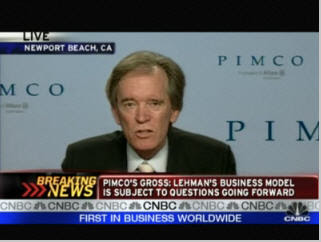
(click above picture to watch)
An Authoritarian Olympics
