Home » 2010 (Page 14)
Yearly Archives: 2010


Business cycle indicator says double-dip is likely
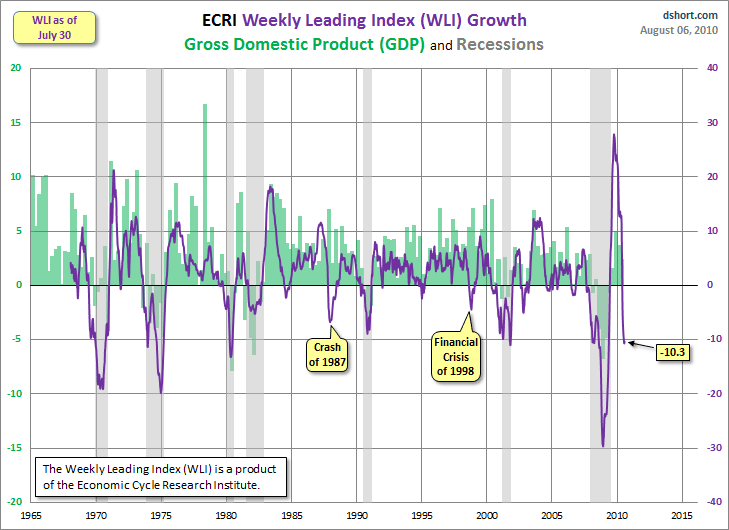
ECRI WLI index says there is a fair chance that double-dip is coming. Here is an analysis I borrowed from dshort.com.
(click to enlarge; graph courtesy of dshort.com)
According to dshort:
A significant decline in the WLI has been a leading indicator for six of the seven recessions since the 1960s. It lagged one recession (1981-1982) by nine weeks. The WLI did turned negative 17 times when no recession followed, but 14 of those declines were only slightly negative (-0.1 to -2.4) and most of them reversed after relatively brief periods.
Three of the false negatives were deeper declines. The Crash of 1987 took the Index negative for 68 weeks with a trough of -6.8. The Financial Crisis of 1998, which included the collapse of Long Term Capital Management, took the Index negative for 23 weeks with a trough of -4.5. The third significant false negative came near the bottom of the bear market of 2000-2002, about nine months after the brief recession of 2001. At the time, the WLI seemed to be signaling a double-dip recession, but the economy and market accelerated in tandem in the spring of 2003, and a recession was avoided.
The question, of course, is whether the latest WLI decline is a leading indicator of a recession or a false negative. The index has never dropped to the current level without the onset of a recession. The deepest decline without a near-term recession was in the Crash of 1987, when the index slipped to -6.8.
David Rubenstein Interview on Charlie Rose
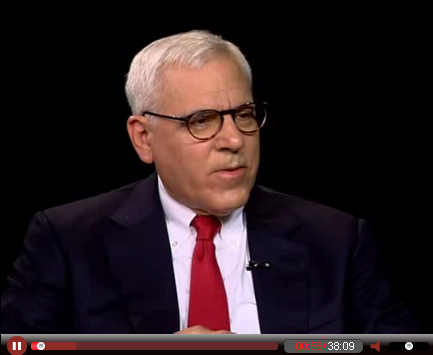
A very intriguing interview of David Rubenstein, co-founder of private equity firm The Carlyle Group.
He talks about current economic challenges, the performance of Obama Administration, and US’ strategy to deal with a fast rising China.
Rubenstein’s firm is the most active PE firm in China. Something most interesting to note is Rubenstein is also the owner and collector of Magna Carta, probably the most important historical piece documenting the development of Western property rights.
(click on the image above to view the video; Source: Charlie Rose)
Testing religious freedom
America, the land of free speech and free religion, is facing some rather testy issue on whether to allow Muslims to build their mosques. In Copenhagen where I'm living now, there is a quite large Muslim population, and I find mosques are not few and far between. In contrast, in the US, where I lived for nine years and traveled intensively, probably I only saw one mosque, personally, near Hartford, CT.
Read the report from NYT.
India Needs Manufacturing
Compare India and China – China's manufacturing accounts for over half of national GDP, India only 16%. India's advantage is its service sector, especially IT industry, but it is also its disadvantage, as IT industry is capital-intensive, the opposite of what India is rich for. The service sector's contribution to the country's employment is just 12%.
Both China and India are labor-intensive. Plus, India is forecast to have much bigger labor supply than China in coming years. Indian government needs to change its current rigid labor laws and regulations to encourage development of its own manufacturing industry. This will simultaneously achieve diversification of its IT-specialized economic structure, and create more employment opportunities for the common poor.
Economist Magazine's report on India's "Himalayas of Hiring" in manufacturing:
LABOUR is cheap in India: signage is painted by hand; bricks are piled nine-high on the crowns of construction workers; shops are more crowded with attendants than customers. As China’s workforce becomes older, costlier and stroppier, some firms will look to exit the dragon. Only India has the numbers to match it.
According to the International Labour Organisation, the number of Indians in the workforce will increase by almost 80m over the next decade. But that is an understatement, argues a new paper* by Tushar Poddar of Goldman Sachs and Pragyan Deb, now at the London School of Economics (LSE). Only a third of Indian women currently seek paid work, they point out (other estimates are even lower). If that figure rises to 38% by 2020, then the Indian workforce will swell by 110m, they reckon. Three out of every ten extra workers in the world will be Indian.
India’s renowned services sector will employ about 45m of them, the authors forecast. But 40m will have to find work in industry. Overshadowed by India’s digital dynamos, India’s widget-makers are no slouches. Manufacturing grew at a perky 8% annual rate over the past decade and in the last fiscal year contributed a greater share (16.1%) of India’s GDP than agriculture for the first time in the country’s history. But its contribution to employment is less impressive: just 12%.
Unfortunately, India’s manufacturers economise on labour, despite its abundance, favouring capital or technology instead. … in industries such as clothing, jewellery and toymaking, the ratio of labour to capital halved over the 1990s…The regiments of assembly-line workers characteristic of China’s industrial revolution are harder to find in India. Several scholars have identified a “missing middle” in Indian manufacturing: workers cluster either in minuscule factories or large and sophisticated ones (see right-hand chart).

What is deterring Indian manufacturers from hiring more people? Messrs Poddar and Deb name India’s “archaic labour laws” as the “biggest challenge” among many to industrial growth. According to India’s employers’ association, the central government imposes over 55 labour laws and the states another 150 or more. The most notorious is the Industrial Disputes Act, which requires any establishment employing 100 or more workers to ask the state’s permission before firing anyone.
Will the Fed roll over asset purchases?
Two former Fed. Board of Governors (one being Fred Mishkin) discuss the issue. Fed’s action in coming weeks is likely to have a big impact on both bond market and currency market.
Mishkin took the view that it would be a mistake for the Fed to continue buying asset-backed securities or buying treasuries directly.
update 1.
Another discussion on the same issue:
What’s behind Euro’s sharp rebound?
The biggest banks are unwinding their short positions against Euro. Whenever a large number of negative bets on a currency is closed, that currency climbs.
Some of the world’s most prestigious foreign-exchange banks are ripping up their gloomy forecasts for the rallying euro.Several of the top banks in the business are backtracking on their previously dire predictions for the single currency, most of which were formed when the European monetary union itself seemed in peril during April and May this year.
Some believe this is nothing new, a natural consequence of the market’s stabilization after an extraordinary run of events for major currencies this year. However, some industry veterans say that the market is now beholden to new forces that few if any market watchers yet fully understand.
…On Monday, Switzerland’s UBS AG —the world’s second-biggest bank in foreign exchange—tore up its forecast for the euro to be trading at $1.20 against the dollar in the next month. It now expects to see the currency at around $1.28—a 6% revision.
In a separate research note, the bank described the euro as “exasperating,” adding that the currency’s rally from under $1.19 in early June to over $1.30 by late July had “wrong-footed many in the currency market.”
Other banks caught off guard include Credit Suisse, another top-10 operation, which in late July upgraded its three-month forecast for the euro’s level against the dollar to $1.30 from $1.16, citing, in part, “a more rapid than anticipated recovery in euro-area policy credibility.”
BNP Paribas SA, whose analysts have held some of the gloomiest views of any in the market, took a similar step towards the end of July. “We still expect the euro to trade lower against the dollar, but the trough should be near $1.10 rather than $0.97,” the bank said.
European regulators’ stress tests on the region’s banks have played a big role. The generally upbeat results were roundly criticized when they were released July 23, but longer-term, the tests have rebuilt confidence in Europe’s financial sector and eased nerves over the euro area’s government bonds.
In addition, concerns that the U.S. may slip back into recession, and that the U.S. Federal Reserve may be drawn into further bond purchases to support the economy, took many in the market by surprise, and hit the dollar hard.
…
“We don’t often get extremes of pessimism like we had in April and May. It was dangerous,” said Marshall Gittler, a director and chief strategist at Deutsche Bank Suisse SA in Geneva, who has been watching the currencies market since 1998.
“We have gone from an Armageddon scenario, where some people thought the euro really might break up, to euphoria, or at least a return to normality, in a very short time,” he said.
…
Mr. Brown at Mitsubishi said that the sorts of hefty revisions banks are making now are a common part of the market’s rhythm. “My broad view is that it’s no harder to predict currency movements than it ever was,” he said.
Apple brings TOUCH to desktop
Finger control to desktop, introducing the very cool Magic Trackpad from Apple:
Dems will have a very bad mid-term election
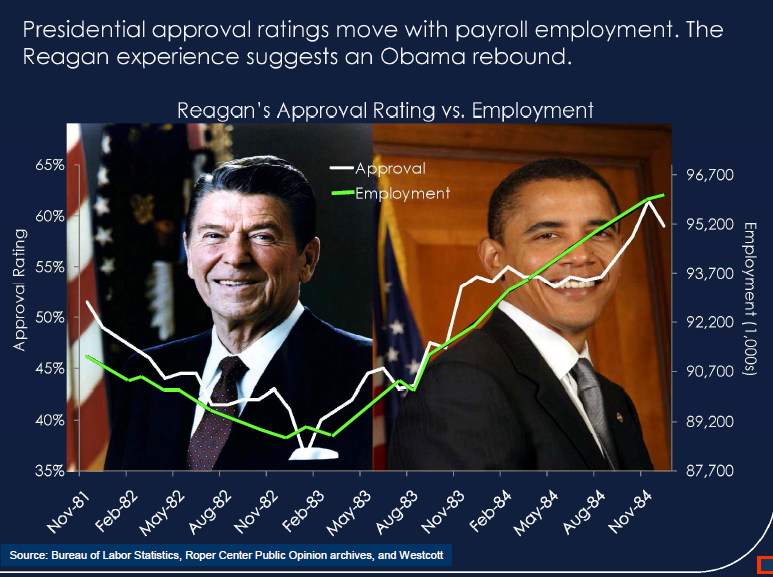
With unemployment rate staying close to 10%, and not going to come down in the next couple of years, Democrats are set to have a very bad year in the Nov. mid-term election.
History tells Presidential approval rating and payroll are highly correlated.
(click to enlarge)