Home » 2010 (Page 15)
Yearly Archives: 2010


Rosenberg on US economic outlook
David Rosenberg, one of the most vocal bears out there, argues for his case of the US falling into double-dip recession. His assessment of the current condition is convincing, but with Bernanke Fed’s determination to prevent another modern-day Great Depression, I would bet my money on a slow-recovery (or New Normal) scenario. Call it Square-root recovery: big dip followed by a sharp rebound, then followed by years of anemic growth.
Will China surpass the US?
An interesting question ask, and a nice debate to watch.
My 2 seconds on this: China’s TOTAL GDP, now about 1/3 of the US, will catch up with the US in around 2020-2025 – for this I have no doubt. China is not another Soviet Union – China’s political party is still called Communist Party, but if you ever travel to China, and talk to the average people there, you will immediately know China is the most capitalist country in the world – travel makes you smarter 🙂
The much more difficult task is to lift the living standards of average Chinese citizen to the US level – China’s GDP per capita is only 1/10 of the US – and build up stronger and better institutions, especially political and legal ones, to sustain the long-term growth. For this, China has a lot to learn from the US.
Tax ticking time bomb
The Obama administration is pressing to extend the Bush tax cuts for everyone with an income under $250,000 a year and to raise taxes on those above.
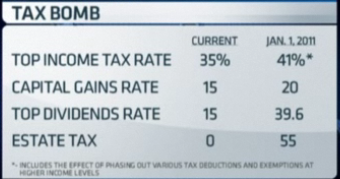
This so-called middle-income tax cut first sounds very fair, but until you look deep into it. We know most small-business households earn more than $250k, and they are the main job creator of the US economy. You simply don’t want to raise job-generator’s tax during time of huge economic uncertainties with very high unemployment.
Bill Gross: Investment outlook
Bill Gross says new growth thrust has to be put into US economy. The current policy is just to flush money into toilet.
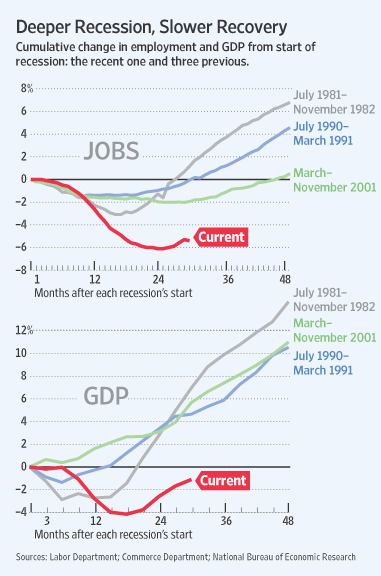
Deeper recession, slower recovery
Friday’s GDP growth in 2Q came out as 2.4%, showing the recovery is losing momentum.
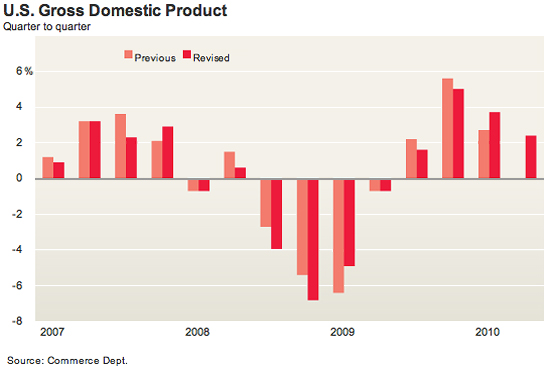
(click to enlarge; source: WSJ)
Once again confirming this is not your average-Joe recession (see chart below):
Prevent the next deflation – What’s left for the Fed?
From Bernanke’s speech in 2003:
Should the funds rate approach zero, the question will arise again about so called nontraditional monetary policy measures. I first discussed some of these measures in a speech last November. Thanks in part to a great deal of fine work by the staff, my understanding of these measures and my confidence in their success have been greatly enhanced since I gave that speech.
Without going into great detail, I see the first stages of a “nontraditional” campaign as focused on lowering longer-term interest rates.
The two principal components of that campaign would be a commitment by the FOMC to keep short-term yields at a very low level for an extended period together with a set of concrete measures to give weight to that commitment.
Such measures might include, among others, increased purchases of longer-term government bonds by the Fed, an announced program of oversupplying bank reserves, term lending through the discount window at very low rates, and the issuance of options to borrow from the Fed at low rates. I am sure that the FOMC will release more specific information if and when the need for such approaches appears to be closer on the horizon.
Deflation Threat: Is America another Japan?
Does America face Japanese-style deflation?
America’s Lost Decade, part 4
This is a post following my previous posts on the same topic, see p1, p2, p3.
When discussing the issue, most people focus on GDP growth. Yes, in terms of GDP growth, in the past decade, the US still managed to grow 18%, cumulatively – that’s roughly 1.8 percent per year on average. However, in terms of employment growth, it has been a lost decade for the US (see the chart below).
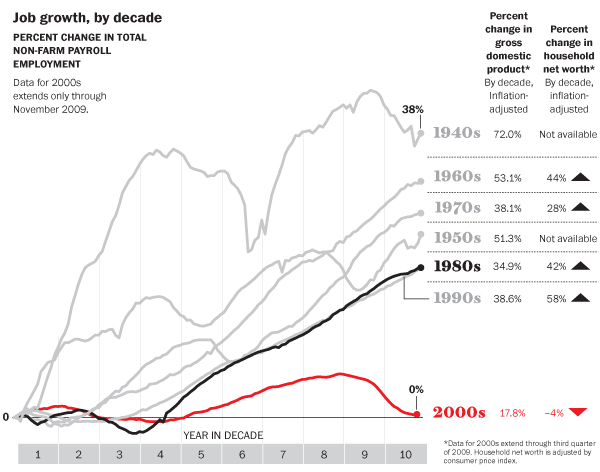
(click to enlarge)
Given the economic dynamism in the US, and compare it to Japan, I have long thought the Lost Decade would never happen in America, a land full of opportunities.
I guess I need to re-visit my presumptions — Whether a big housing bubble (in the US’ case, two big bubbles in one decade) always foretells anemic economic growth afterward, as opposed to the common belief that Japan’s lost decade was largely due to policy mistakes. Maybe, in the aftermath of a big bubble, America and Japan are really not that much different – an open question.