Home » 2010 (Page 20)
Yearly Archives: 2010


Not even the end of the beginning
WSJ analyzes why investors are still betting down Euro and Greece:
This is not the beginning of the end, not even the end of the beginning. The International Monetary Fund and euro zone’s €110 billion ($145.37 billion) three-year Greek debt support package still needs to be given final approval by 15 euro-zone leaders. They in turn must satisfy themselves—and their national governments and voters—that there’s a reasonable chance their loans can be refinanced, rather than turning into a straight fiscal transfer. That’s far from certain.
First, the plan does not buy Greece quite as much time as it appears. Of the €110 billion headline figure, €10 billion is going to a Financial Stability Fund to support Greece’s banks. Greece needs around €30 billion for 2010; for 2011-2012 debt and interest payments alone total €93 billion, according to Barclays Capital. So even with the program, Greece is likely to need to return to the markets in late 2011 or 2012. Ideally it would return as soon as possible, if the plan works.
Second, debt will still be rising in 2011 and 2012, topping out only in 2013 at an eye-watering 149% of GDP. In 2012, the budget deficit is still forecast to be 6.5% of GDP. Greece’s credit ratings may then be even lower than they are today; this may further complicate market access. Bond investors will have to be convinced already in 2011 that the debt trajectory and economy will turn around decisively, in order to engender private interest in Greek debt.
True, the new plan is at least realistic, recognizing the damage the economy will suffer: Greek GDP is assumed to shrink 4% in 2010 and 2.6% in 2011, before growing just 1.1% in 2012. The total fiscal adjustment of 11% of GDP is now in line with economists’ assumptions of the scale of effort necessary. And there will be quarterly monitoring of progress; International Monetary Fund involvement should boost credibility.
But the deal faces substantial execution risks: The Greek government is facing growing domestic opposition to its new austerity program announced last weekend, which includes further public-sector pay cuts and a VAT increase. Success also depends on global growth remaining robust as Greece is ill-equipped to deal with any fresh external shocks.
Euro-zone leaders may persuade themselves they have to endorse the package since any alternative, such as a restructuring, would be so traumatic. But they need to be clear about the risks: Even if the Greek economy performs in line with the IMF’s projections, they may yet need to provide further support packages as private lending starts to re-engage. The euro-zone’s engagement with Greece is likely to be a lengthy one.
Euro is breaking down…
Euro reached its lowest level against US dollar since April 2009, now trading below 1.30 $/euro. Looks like the market is not happy about the huge costly Greece rescue plan put out by Germany-led EU and IMF.
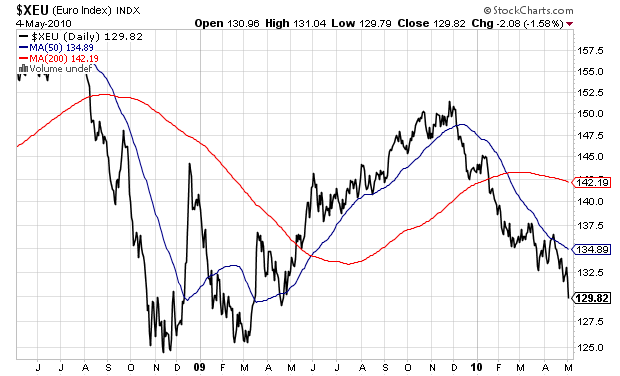
We are also seeing signs of contagion, to Portugal and Spain…now let’s see if the Euro can hold at 1.25 level. If not, Euro will have a real problem.
Mishkin: economy so far so good
But the recovery is weaker than the strong recoveries that usually happened after a severe downturn, such as 1981 recession. It’s a more U-shaped recovery than V-shaped.
Now all the focus will be on the jobs.
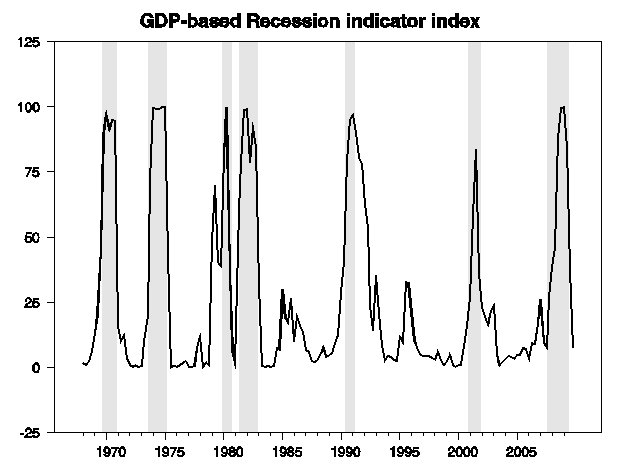
Recession is definitely over…
Jim Hamilton says the recession is definitely over after the recent GDP data. My guess was that the recession ended sometime between June and September in 2009.
What US needs
Frugality…Frugality… Frugality.
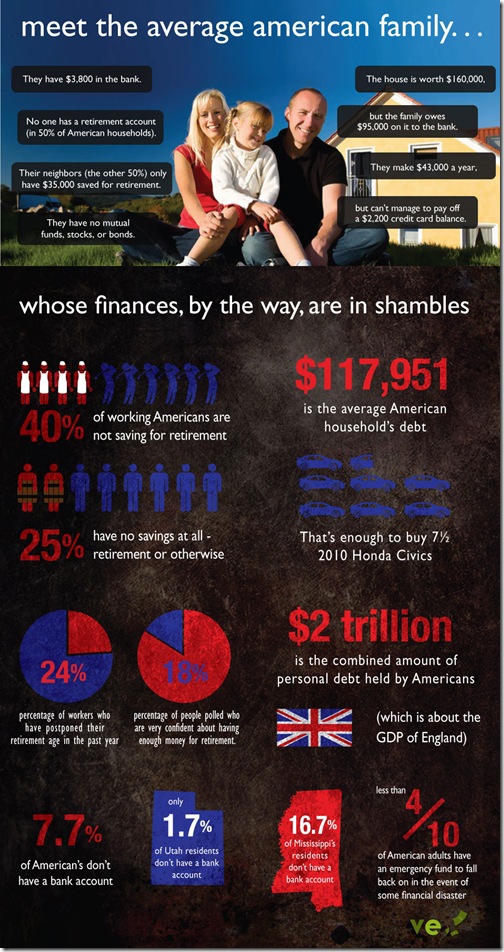
(click to enlarge; graph courtesy of Paul Kedrosky)
Goldman impact
WSJ ponders on what impact the criminal charge against Goldman will bring to the firm:
As Goldman Sachs Group faces legal challenges, watch the firm’s top ranks.
Goldman shares fell 9% Friday on news that federal prosecutors have opened a criminal investigation into whether Goldman, or its employees, committed securities fraud. The probe isn’t surprising, given the allegations laid out several days ago in the Securities and Exchange Commission’s civil lawsuit. But investors now have to contemplate what potential legal outcomes might mean for Goldman.
The best and wholly plausible scenario for Goldman is that the Manhattan U.S. Attorney’s Office doesn’t indict anyone. This could dent the credibility of the SEC case and affirm management’s strategy of responding forcefully to the agency’s allegations. However, it could be a long time before prosecutors’ intentions are known. Investors may have to wait before they can completely discount the nuclear option, the indictment of Goldman as a firm.
Another outcome: Goldman employees, not the firm, get hit with criminal charges. Goldman might feel confident any charged employees will be vindicated, especially since prosecutors lost their case against former employees of Bear Stearns Asset Management. But if legal uncertainties keep pressure on Goldman stock, shareholders, who recently became vocal over compensation at the firm, might become restive.
Investors may then look for a way to accelerate an end to the legal uncertainty and perhaps even push for trading to be de-emphasized. That could raise questions over the future of top-level executives, given that several have trading backgrounds and have tilted Goldman toward that business.
Still, Goldman has been around for over 140 years—and, as savvy traders will tell you, sometimes you have to ride the bumps for things to pay off over time.
World Bank reforms voting power structure
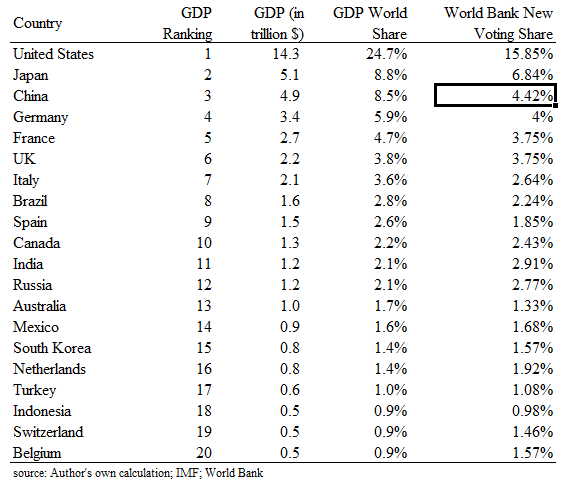
On April 25, the World Bank again restructured its voting share among countries. The new structure reflects the rising power of developing and transitional economies, especially China. Now the voting share is more aligned with country’s GDP share in the world.
China’s voting power was increased from 2.27% to 4.42%. The similar reform is also widely expected at IMF.
Here is a chart I made that compares country’s GDP share with their voting power at the World Bank.
link to the report on the reform.
update 1 ,
Bank of Finland has a nice chart similar to my table above, comparing GDP share with voting power for the top 12 countries.

(graph courtesy of Bank of Finland)
Feldstein: Greek default is a matter of time
Marty Feldstein thinks Greek default is inevitable. I think default is one possible outcome, and the alternative is for Greece to ask EU to be “kicked out” of European Union, so it can depeg itself from Euro zone and use monetary policy to stimulate its own economy.