

Summit after Summit
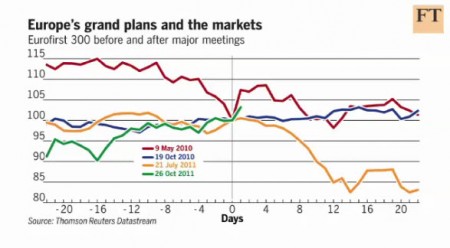
Summit after summit – this seems to be what Europeans are best at. So are Europeans just delaying the inevitable? Europe’s Lehman moment.
Watch this insightful analysis from FT:
(click to watch the video)
America’s ongoing debt deleveraging
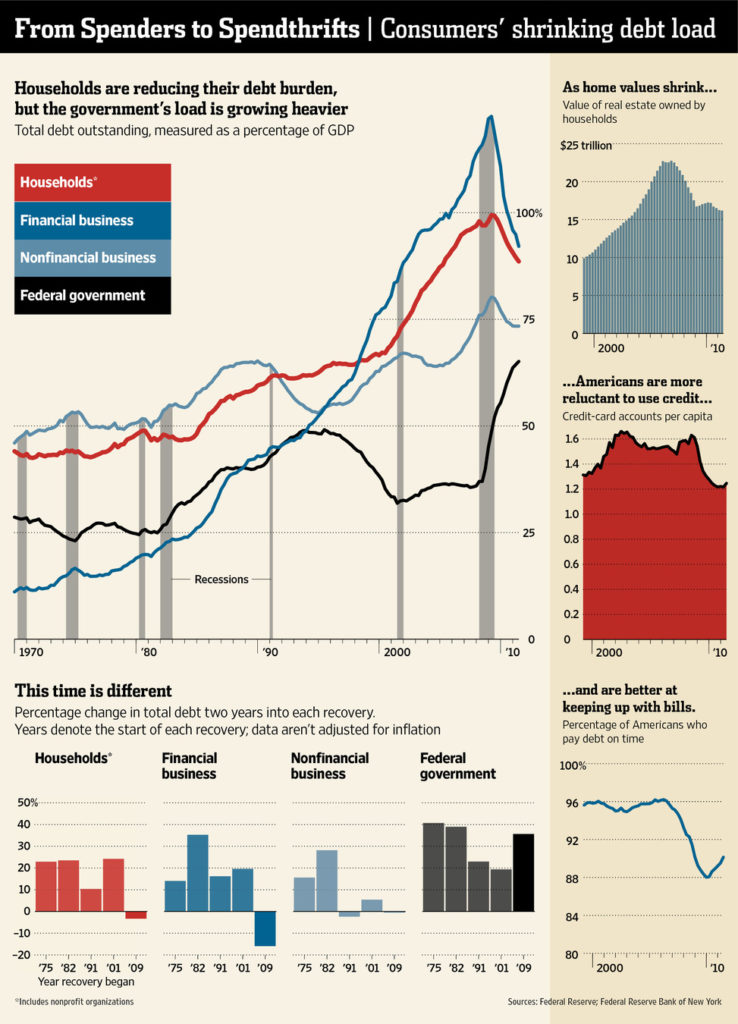
Since the financial crisis erupted, millions of Americans have ditched their credit cards, accelerated mortgage payments and cut off credit lines that during the good times were used like a bottomless piggybank. Many have resorted to a practice once thought old-fashioned—delaying purchases until they have the cash.
As a result, total household debt—through payment or default—fell by $1.1 trillion, or 8.6%, from mid-2008 through the first half of 2011, according to the Federal Reserve Bank of New York. Auto loan and credit-card balances in August had their biggest drop since April 2010, the Federal Reserve said.
“Folks aren’t borrowing,” said Jim Ernest, executive vice president at Provident Credit Union in Redwood Shores, Calif. “They are paying down debt and continuing to save.” Since January, 12% of the credit union’s mortgage customers have made at least $1,500 in extra payments.
Nearly 300 borrowers have made at least $1,000 in additional payments on car loans from Provident, said Mr. Ernest, who confessed he sometimes can’t sleep—Provident’s loan portfolio has shrunk by a quarter since the end of 2008.The change in attitude stretches far beyond Mr. Ernest’s credit-union members: two-thirds of Americans polled online in July by U.K. research firm Absolute Strategy Research said they planned to either reduce their debt within a year or stop borrowing altogether.
…
From 1997 to 2007, household debt ballooned from 66% of economic output to 98%, according to Federal Reserve data. As of June, the percentage had since been whittled down to 89%.
American households closed 103 million credit-card accounts. And credit-card payments exceeded purchases made with plastic by an estimated $116 billion between the end of the first quarter of 2009 and the end of the second quarter of 2011, according to TransUnion LLC.
…
Bernanke Press Conference (Nov. 2, 2011)
Part 1
Part 2
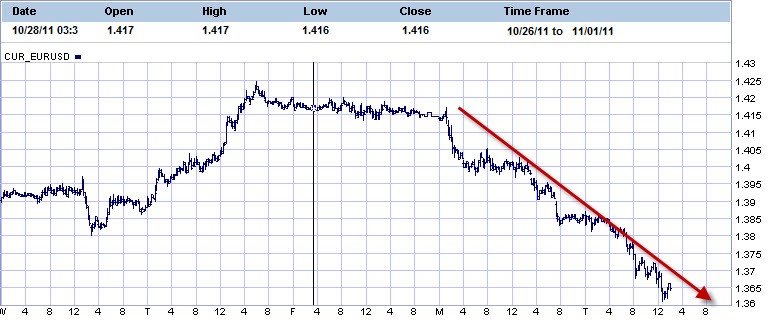
Euro swings back to crisis – big time
Greece just shocked the world:
Greek Prime Minister George Papandreou stunned Europe by announcing a referendum on his country's latest bailout—a high-stakes gamble that could undermine the international effort to preserve the euro.
A "yes" vote in the referendum could deflate the massive street protests and strikes that threaten to paralyze Greece as it tries to enact a brutal austerity program to earn rescue loans from the euro zone and the International Monetary Fund.
A "no" vote, however, could bring down the government and cut off international funding for Greece, leaving the country facing a financial meltdown. The government expects to hold the referendum in January.
Debt Snapshot
A snapshot of debt (government, household and corporate) of world’s advanced economies. For a hint of what’s likely to be the end of the game, read my previous post, “The moral breakdown“.
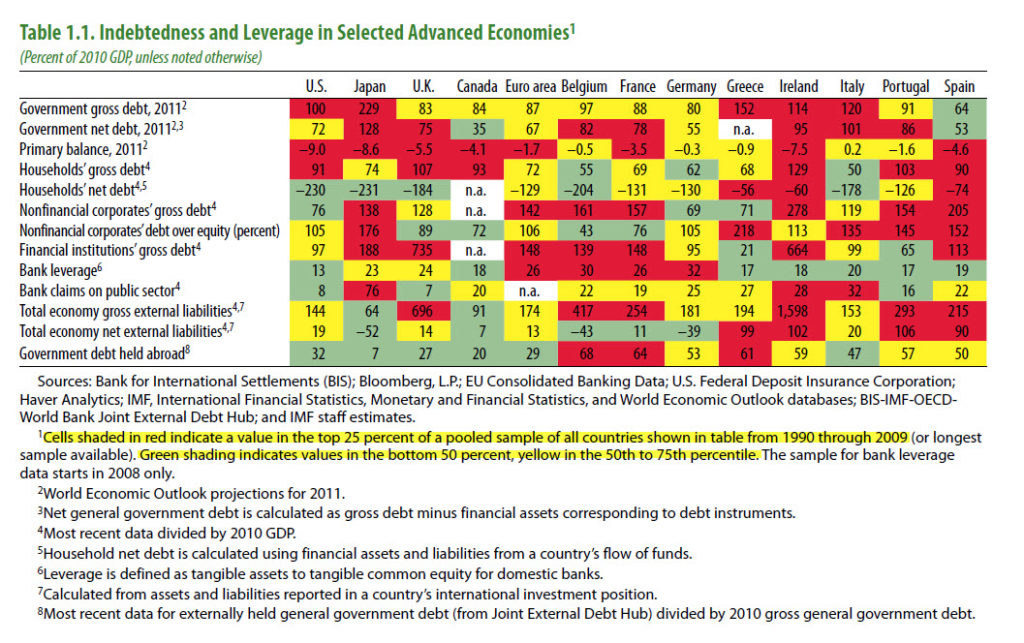
(click to enlarge; source: IMF)
Europe’s debt disease
The following graph was taken out from a recent report on Europe’s debt trajectory by GMO’s Rich Mattione. It pretty much summarizes the current dire situation in Europe.
Greece is not the only country in trouble. Italy is the real threat to the stability of Europe. If Italy falls, Europe falls.
Germany and France, the two largest economies in Europe, are relatively better positioned, but their government-debt-to-GDP ratios, 83% and 82%, respectively, will seriously constrain their ability to bail out the PIIGS (Portugal, Italy, Ireland, Greece and Spain). In contrast, Scandinavian countries enjoy the strongest position in all developed countries, with the debt-to-GDP ratio well below 50%.
[singlepic id=8 w=400 h=300 float=]
Summers still believes in “debt in, debt out”
Interview of Larry Summers. He assesses “double-dip” recession risk and advocates more government spending in order to generate enough demand. With 90% government debt-to-GDP ratio, Summers seems to ignore the fact that the US government is seriously constrained in engaging in further fiscal expansion.
Allan Meltzer, in his piece “Four Reasons Keynesians Keep Getting It Wrong“, offers a classic rebuttal:
Why is the economic response to increased government spending so different from the response predicted by Keynesian models? What is missing from the models that makes their forecasts so inaccurate? Those should be the questions asked by both proponents and opponents of more government spending. Allow me to suggest four major omissions from Keynesian models:
First, big increases in spending and government deficits raise the prospect of future tax increases. Many people understand that increased spending must be paid for sooner or later. Meanwhile, President Obama makes certain that many more will reach that conclusion by continuing to demand permanent tax increases. His demands are a deterrent for those who do most of the saving and investing. Concern over future tax rates is one of the main reasons for heightened uncertainty and reduced confidence. Potential investors hold cash and wait.
Second, most of the government spending programs redistribute income from workers to the unemployed. This, Keynesians argue, increases the welfare of many hurt by the recession. What their models ignore, however, is the reduced productivity that follows a shift of resources toward redistribution and away from productive investment. Keynesian theory argues that each dollar of government spending has a larger effect on output than a dollar of tax reduction. But in reality the reverse has proven true. Permanent tax reduction generates more expansion than increased government spending of the same dollars. I believe that the resulting difference in productivity is a main reason for the difference in results.
Third, Keynesian models totally ignore the negative effects of the stream of costly new regulations that pour out of the Obama bureaucracy. Who can guess the size of the cost increases required by these programs? ObamaCare is not the only source of this uncertainty, though it makes a large contribution. We also have an excessively eager group of environmental regulators, protectors of labor unions, and financial regulators. Their decisions raise future costs and increase uncertainty. How can a corporate staff hope to estimate future return on new investment when tax rates and costs are unknowable? Holding cash and waiting for less uncertainty is the principal response. Thus, the recession drags on.
Fourth, U.S. fiscal and monetary policies are mainly directed at getting a near-term result. The estimated cost of new jobs in President Obama’s latest jobs bill is at least $200,000 per job, based on administration estimates of the number of jobs and their cost. How can that appeal to the taxpayers who will pay those costs? Once the subsidies end, the jobs disappear—but the bonds that financed them remain and must be serviced. These medium and long-term effects are ignored in Keynesian models. Perhaps that’s why estimates of the additional spending generated by Keynesian stimulus—the “multiplier effect”—have failed to live up to expectations.
Understand the new European plan
update 1 (Oct. 30. 2011)
Ken Rogoff comments on the new plan: This is not the end; Euro is half-baked.