Steve Jobs Stories
Walter Isaacson shares his experience writing Jobs’ biography, a lot of interesting secret stories – what to make an innovative man who transformed the whole technology industry.
Part 1
Part 2
Can China keep on going?
Do you feel everything is progressing in China? Or rather China is like a fast car without a reverse gear, destined to crash?
Watch this interesting video analysis, featuring Michael Pettis.

(video courtesy of Journeymanpictures)
No hard landing for China, or is it?
Here I included two pieces to address the question whether China will have “hard landing” or not. Hard landing is a fancy phrase to describe the situation when government tries control high inflation, it slams on the brake to dramatically slow down the economy, often leading to the outright recession. In China’s case, a hard landing, along with rising interest rate, may trigger the burst of the housing bubble.
The first piece is by Stephen Roach, former Chief economist, and Asian Chairman at Morgan Stanley, now a professor at Yale University. The second piece is a recent interview of Jim O’Neill, Chairman of Goldman Sachs’ Asset Management (or GSAM). Both are leading authorities on Chinese economy.
Roach took a big-picture view, and argues China is more likely to have a soft landing, not hard landing.
China’s economy is slowing. This is no surprise for an export-led economy dependent on faltering global demand. But China’s looming slowdown is likely to be both manageable and welcome. Fears of a hard landing are overblown.
To be sure, the economic data have softened. Purchasing managers’ indices are now threatening the “50” threshold, which has long been associated with the break-even point between expansion and contraction. Similar downtrends are evident in a broad array of leading indicators, ranging from consumer expectations, money supply, and the stock market, to steel production, industrial product sales, and newly started construction.
But this is not 2008. Back then, global commerce was collapsing, presaging a 10.7% drop in the volume of world trade in 2009 – the sharpest annual contraction since the 1930s. In response, China’s export performance swung from 26% annual growth in July 2008 to a 27% contraction by February 2009. Sequential GDP growth slowed to a low single-digit pace – a virtual standstill by Chinese standards. And more than 20 million migrant workers reportedly lost their jobs in export-led Guangdong province. By late 2008, China was in the throes of the functional equivalent of a full-blown recession.
Thanks to a massive fiscal stimulus, China veered away from the abyss in early 2009. But it paid a price for this bank-funded investment boom. Local governments’ indebtedness soared, and fixed investment surged toward an unprecedented 50% of GDP. Fears surfaced of another banking crisis, the imminent collapse of a monstrous property bubble, and runaway inflation. Add a wrenching European crisis to the equation, and a replay of 2008 no longer seemed far-fetched.
While there is a kernel of truth to each of these China-specific concerns, they do not by themselves imply a hard landing. Nonperforming loans will undoubtedly increase in response to the banking sector’s exposure to some $1.7 trillion of local-government debt, much of which was incurred during the stimulus of 2008-2009. But the feared deterioration in loan quality is exaggerated.

Jim O’Neill Interview (courtesy of CNBC): He thinks the chance for a hand landing is very slim.
Update 1 (Oct. 30, 2011):
Jim Chanos share his recent view on China – he continues to short China’s banking sector and real estate developers. He believes Chinese banking system just started to have cracks; there is more to come.
Interview of Gao Xiqing of CIC
Charlie Rose’s interview of Gao Xiqing, President of China Investment Corporation – China’s Sovereign Wealth Fund.

Marc Faber on ways to cure the debt disease
Interview of the outspoken Marc Faber:
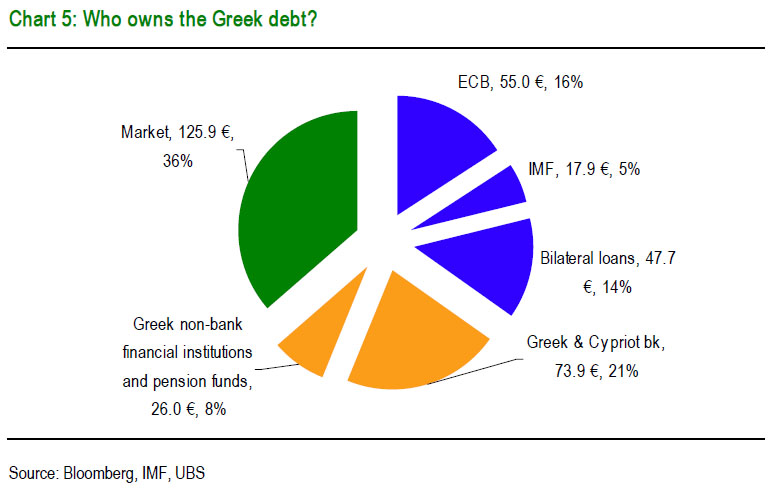
Who owns Greek debt?
Greece has total debts of €346.4bn. About a third of this debt is in public hands (34.8% is attributable to the IMF, ECB and European governments), roughly another third is in Greek hands (28.8%, essentially for banks) with the remainder (36.4%) held by non-Greek private investors.
The impact of a Greek default
Insightful analysis from FT: