Home » 2010 (Page 22)
Yearly Archives: 2010


Another big hit for Greece and Europe
Greek debt got downgraded again by Moody's, and Euro against US dollar continue to go down, reports from the Journal:
The credit ratings agency's move to reduce its rating on Greece to A3 from A2 came after the European Union's statistical authority cast fresh doubt on the accuracy of Greece's financial reports and said the country's 2009 budget deficit–already yawning–was wider than previously thought.
The news sent Greek bonds into a tailspin, with the yield on a Greek 10-year bond nearing 8.7%, and all but dashed any remaining hopes that Greece might borrow afresh from international markets.
The euro also dropped on the news to $1.3257, its lowest level since May 2009.
China bubble getting deflated…
Recent bubble pricking measures by China’s policy makers have had a big impact on the price of China’s real estate market. I think in general this is healthy for China – the earlier the bubble got deflated, the less damage will the bubble bursting do to the Chinese economy. As I said before, China stands at the forefront of bubble containing experiment. Let’s see how far the government measures can go…but so far, I like what I have seen.
Here is the latest report from WSJ.
The global economic recovery has drawn support from a swift rebound in China. Now, investors and economists wonder whether a bursting Chinese property bubble could put China’s economy in a bind.
![[AINVEST]](https://sg.wsj.net/public/resources/images/AM-AI974_AINVES_NS_20100420132601.gif)
Over the past week, China’s cabinet has announced measures aimed at cracking down on property speculators, including tougher down-payment requirements for second and third homes. This comes after China reported an 11.7% rise in urban home prices last month from a year earlier, its fastest gain in five years.
“This is the critical policy point that finally cracks the Chinese property market,” declared Morgan Stanley China strategist Jerry Lou.
All this could be seen as bolstering the case for short-seller James Chanos. The name of Mr. Chanos’s $6 billion hedge fund, Kynikos Associates LP, means “cynic” in Greek—appropriate since the New York-based money manager earlier this year made himself the world’s best-known cynic when it comes to China’s growth story.
“What we’re talking about is a world-class, if not the, world-class property bubble,” Mr. Chanos said in an interview with Charlie Rose, comparing conditions in Chinese cities to Dubai and Miami. He predicts the bubble will begin to unravel later this year.
Mr. Chanos argues that China’s lending spree during the financial crisis has pumped too much money into real estate, and that housing prices have surpassed affordability.
Among the counter-arguments: China’s growing wealth feeds a long-term demand to upgrade the country’s housing stock, and regulators put a tight cap on loan-to-value ratios, limiting the downside of any bubble. Some note that China’s government, using measures such as those announced in the last week, has long avoided a crash in housing prices.
Those inclined to favor Mr. Chanos’s analysis—or who at least believe that some kind of correction is likely—could try to emulate his strategy. He is betting on a decline in the price of Hong Kong-listed Chinese property developers and other companies linked to China’s property market, such as those exporting cement and copper to China.
![Reblog this post [with Zemanta]](https://img.zemanta.com/reblog_e.png?x-id=9b3c4ae9-df28-423e-95a0-b28bac57edd0)
Pig production in comparative perspective
Having lived in Denmark for almost 8 months now, I often heard people told me — In Denmark, there are more pigs than people. Indeed, in Danish stores, you can buy all kinds of products from all parts of pig… much more varieties than in the U.S. It’s almost like in China, where people tend to eat a lot of pork.
To put things into perspective, I made an interesting Pig Chart, where I compare country’s pig population with their (human) population (see chart below):
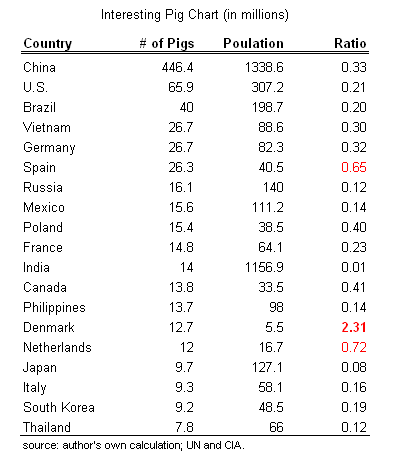
China produces world’s most pigs — in fact, China alone produces more bigs than the total of the next 20 countries combined.
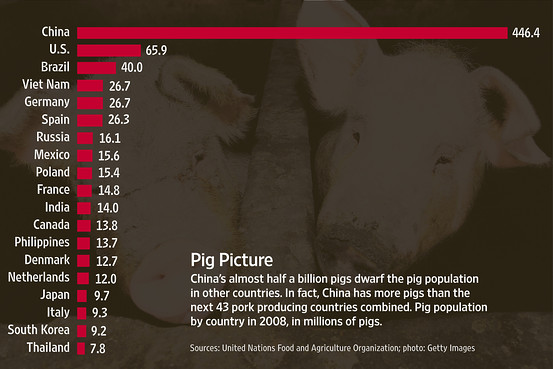
(graph courtesy of WSJ)
But Denmark surpasses China in relative term. When it comes to pig production per capita, Denmark ranks world’s NO. 1. The interesting fact is in Denmark, the number of pigs is 2.3 times of Danish population.
The next big pig producing countries are Netherlands and Spain — their pig production per capita is 0.72 and 0.65, respectively.
China’s bubble pricking experiment, part 2
More update after my previous post on China’s curbing on real estate bubble:
Can Corporate America carry the spending torch?
This recovery, from now on, will all count on Corporate America. Government can’t stimulate the economy forever, eventually it will need (or will be forced by market) to cut down budget deficits. American consumers are straggled too — too much debt accumulated in the past, banks are tightening consumer credit, and unemployment rate remains high at nearly 10%.
With interest rate staying super low (slightly above zero), the financing cost for Corporate America looks dirty cheap. Flushed with easy money, Corporate America may soon carry on the spending spree. There are early signs that this recovery will be led by Corporate America instead, especially the tech. sector, not by American consumers.
It’s true that consumer spending accounts for nearly 70% of US GDP, but corporate spending and early hiring may revive consumer confidence (hopefully), and put the economy into an positive feedback-loop (call it virtuous cycle).
Here is a report from the Wall Street Journal on the reviving corporate spending:
The global recovery has reached a key transition stage: can corporations take up the spending baton from governments? They’ve got the cash but do executives have the confidence? Doubts about final demand, the strength of the recovery and mounting sovereign risks have so far caused boards to hold back on investment. But with Western households and governments requiring substantial deleveraging, only a revival in corporate spending will safeguard the recovery as stimulus programs wind down.
Corporate spending fell off a cliff during the recession, forcing governments to take up the slack. U.S. nonresidential investment plunged 17.8% in 2009. But companies are generating cash and balance sheets are strong; credit ratings upgrades are starting to outstrip downgrades. U.S. nonfinancial free cash flow is 2.8% of GDP, a near-40-year high, according to Credit Suisse. Debt funding is also cheap and available: average U.S. long-term corporate-bond yields are close to 40-year lows, Moody’s data shows. European credit spreads are likely to tighten further even after last year’s rally, according to Citigroup.
Crucially, investors may now give executives the thumbs-up for spending: for the first time since December 2007, fund managers rank capital expenditure and dividends as higher priorities than deleveraging, a Bank of America Merrill Lynch survey showed this week. Companies are thinking the same way: a survey of over 50 large European companies by Credit Suisse found 63% are now looking to maintain or boost spending in the next 12 months, compared to 27% in the last six months, with cash flowing to new hiring, advertising and IT.
Whether this spending materializes depends on confidence. There are some promising signs. Both in the U.S. and Europe, manufacturing and trade are picking up. Euro-zone exports hit a 15-month high in February and trade within the currency bloc climbed 8% on last year. But the headwinds remain severe. Final demand is largely reliant on Asian and emerging market consumers. Corporations may be squeezed through higher taxes. And if borrowing rises, companies may have to compete with governments for capital.
The fate of the recovery now lies in the hands of corporations. Fear of a double-dip recession that deters corporate spending may yet prove self-fulfilling.
also read tech sector led hiring drive
What needs to be done now, more urgently, is to find ways to incentivize banks to lend to small businesses. Banks got scared in this crisis – they still let huge reserves sitting on their books, reluctant to lend.
Cathy Mann of Brandeis University suggested that the Fed raise interest rate so to make banks’ financing cost marginally more expensive, offering them more incentive to lend the money out. This can be a good option.
Market impact of rising Yuan
WSJ had a very nice analysis on the potential impact of a rising Yuan. Nobody will know how much the appreciation will be, 3%, 5%, or 10%? Will it be gradual or one-step revaluation?
But rising Yuan will make imports into China cheaper, increasing domestic demand for imported goods, especially energy and commodities. Also, an appreciation of Yuan means relative devaluation of the US dollar, which is also good for commodity prices – there is a very strong correlation between falling dollar and commodity price, including gold.
Another impact could be negative on US treasuries. According to the analysis, “Ripples from the currency markets could spread to U.S. Treasurys, as Chinese and other Asian governments, with fewer dollars on their hands, buy fewer U.S. Treasurys. Worries of reduced demand from China could result in a short-term selloff, …In 2005, 10-year Treasury yields jumped from 4.17% to 4.41% in the 14 days after the July revaluation. And from August through December of that year, China’s net purchases of Treasurys slowed to a monthly average of $2.7 billion, from $10.5 billion in the previous seven months, according to Treasury Department data.”
On the timing of the revaluation, the Journal points out that Chinese policy makers will avoid appreciation close to US’ mid-term election, in order not to leave impression that they bow to the US pressure. So a reasonable estimate is China will probably re-valuate between May and September — my own guess.
When China allowed the yuan to rise in 2005, it startled investors and sent waves through the financial markets. This time around a revaluation is widely expected. So will a higher yuan turn out to be a big yawn?
![[ABREAST]](https://sg.wsj.net/public/resources/images/MI-BC764_ABREAS_NS_20100418175625.gif)
Not necessarily. Based on the experience of 2005, a rising yuan could boost other Asian currencies, lift commodity prices and hurt U.S. Treasurys. Domestic-focused Chinese stocks are also likely to rise. With China being an even bigger economic force throughout the global economy, sucking up commodities and dominating exports, the market effects could be bigger this time around. While some market moves have begun in anticipation of a policy change—oil prices are up and Asian currencies are rising—some analysts believe the market may be underestimating the size of any revaluation, leaving open the chance of a bigger-than-expected reaction when a change comes.
The currency markets have for months expected the Chinese currency to rise a bit more than 3% this year. That would take the dollar down to roughly 6.60 yuan from 6.80 yuan, where it has been pegged since 2008. At that time the financial crisis prompted China to put a halt to the gradual, 21% appreciation allowed since July 2005. But analysts at Morgan Stanley believe China could drive the yuan up 4% to 5% in several steps in 2010, and take the yuan to 6.17 by the end of 2011. Barclays Capital analysts also expect a gradual 5% increase this year. So far, the markets are betting on China making a gradual and modest move. … full text here.
Stiglitz on New Economic Thinking
Stiglitz’ FT interview:

Economist Magazine had a related article on the state of economics:
IN 1996, David Colander of Middlebury College, in Vermont, expressed his dissatisfaction with decades of economics by invoking a lofty analogy. He felt macroeconomists had clawed their way up a mountain, only to discover, when they broke through the clouds, that a neighbouring mountain would have taken them higher.
…
There was gentle resistance from some well-adjusted economists. Mr Colander’s analogy does not imply that economists are getting nowhere: they can make progress up their chosen peak, even if other, higher mountains beckon. Mainstream models of the macroeconomy, for example, are more sophisticated than they were, allowing for different kinds of shocks, better statistical testing and a variety of dramatis personae beyond the economic Everyman of yore. This progress is the result of hard theoretical work in response to successive rounds of criticism. The critics, who don’t think the climb is worth the effort, may not always appreciate quite how far the leading economists have ascended.
The twin peaks image has a further, unsettling, implication. To get from one peak to the other, economists will have to lose a lot of altitude first. To tackle questions in a fresh way, they may have to set aside many of their favourite techniques and methods. This prospect probably explains a lot of the resistance to new economic thinking. Economists tend to cling to whatever assumptions are required to use the techniques they favour